Hemp Pellet Mill

Hemp Pellet Mill for Sale
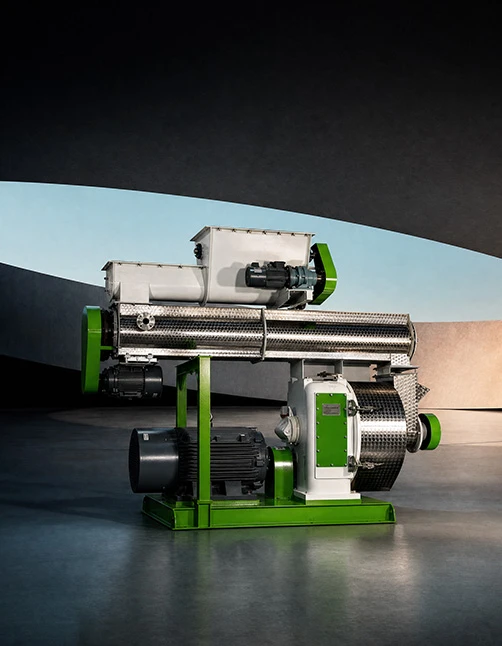
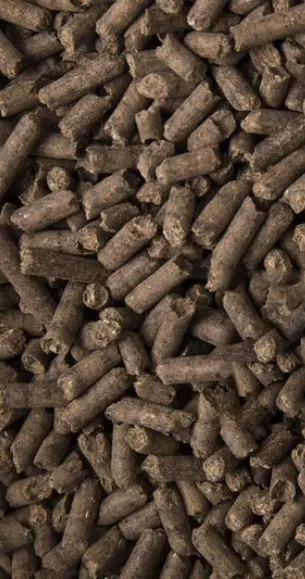
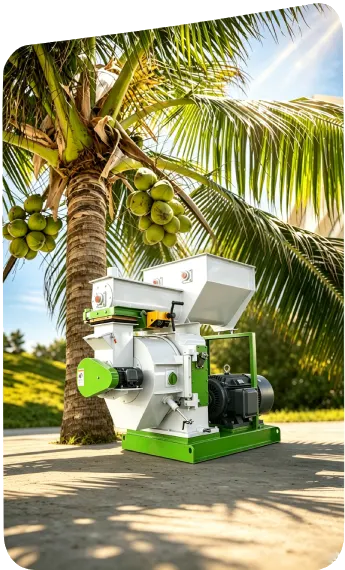
Hemp pellet mill is used to densify hemp leaf residue, hemp hurd, bast fiber, stalk, straw, and other hemp by-products into uniform pellets. The finished pellet size usually ranges from 2 mm to 12 mm, depending on the application. Small pellets are used for certain feeds and bedding products; larger 6–12 mm pellets are common for fuel and ruminant feed.
Hemp Pellet Production

Capacity
0.2-4T/H

Pellet Size
2–12 mm
A hemp pellet mill is a mechanical press that forces ground hemp material through a ring die. The material is fed into the pelletizing chamber, where press rollers push it against the inner surface of the ring die. Because the die holes are smaller than the chamber opening, pressure builds up. The hemp fibers, powders, and binders are compressed into a dense, shaped pellet. A cutter then trims the extruded material to the required length.
Applications of the Hemp Pellet Mill
Industrial hemp refers to low-THC hemp; the pellets produced from it have a wide range of applications, serving as biomass fuel, animal bedding, livestock feed, construction material fillers, organic fertilizer pellets, and more.
01
Fuel Pellets
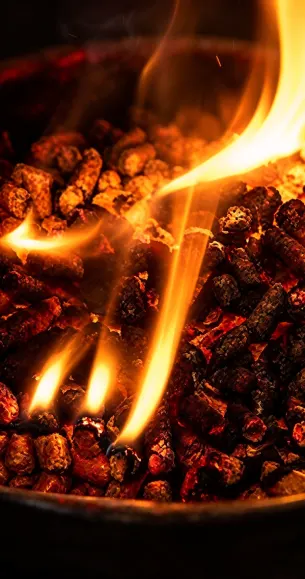
Hemp stalks, straw, and fiber residues can be mixed with ordinary straw, wood chips, sawdust, or other biomass to produce fuel pellets. The ash content of hemp fuel pellets is approximately 2%, which falls within the acceptable range for many pellet boilers and stoves.
02
Animal Feed Pellets
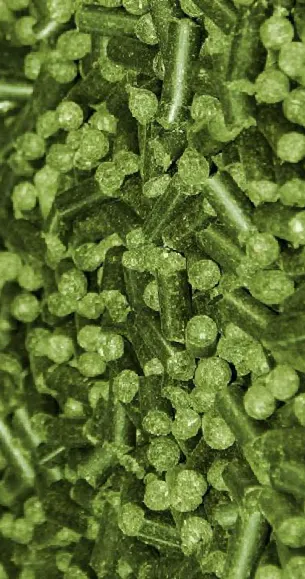
Hemp can be pressed directly into pure grass-type pellets for ruminants. More often, it is used as a base material and mixed with grain, protein meals, minerals, and other concentrates to form a full or near-full ration. The target is a nutritionally balanced pellet for cattle, sheep, goats, and other herbivores. Moisture control is critical: legumes are often pelleted at 14–16% moisture, while grasses are better at 13–15%.

03
Animal Bedding
Hemp hurd and fiber residue, mixed and pelletized, makes an absorbent bedding pellet. The pellet form reduces dust compared to loose shavings — a real advantage in horse barns and poultry houses. You can blend in a small amount of starch or clay to improve clumping if that’s what the end user wants.
04
Organic Fertilizer Pellets
Hemp fiber and shive waste blended with dried animal manure and pelletized. The hemp component adds carbon and improves the pellet’s structural integrity. Manure alone often pelletizes poorly — too sticky, too variable in moisture. The fiber gives it body. Compression ratio is low, around 1:4 to 1:8.
One constraint: if you’re running a fuel line and a feed line on the same machine, you cannot share the die. Fuel dies run higher compression, feed dies run lower. Switching means stopping production, pulling the die, and re-setting the rollers. Plan for that downtime.

How the Hemp pellet mill Works
Video beside this section: hemp pellet machine running and producing pellets.
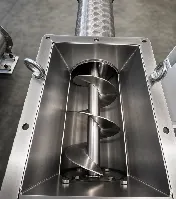
Pre-processed hemp raw material is discharged from silos or buffer hoppers into an anti-bridging feeder. This feeder employs agitation mechanism to ensure the fibrous hemp material remains free-flowing. Subsequently, a variable-frequency screw feeder regulates the material flow and conveys it to a conditioner.
During this stage, steam and moisture are introduced under controlled conditions. The conditioned material drops into the ring die chamber, where rollers force it through the die holes. Cutters then sever the formed pellets to the desired length. The hot pellets proceed to a cooler (typically a counter-flow cooler) before finally being sent to screening equipment and packaging scales.
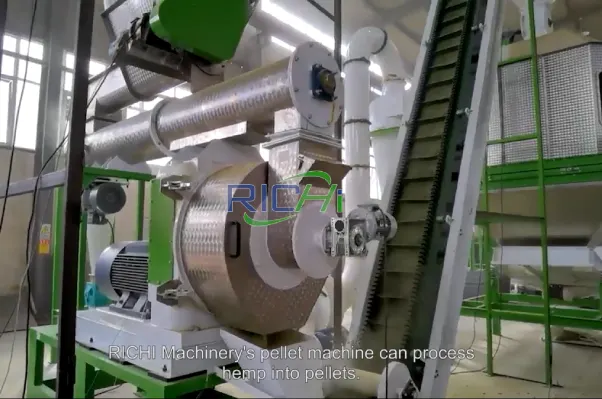

We provide free factory‑on‑site testing for customers. Bring your hemp raw materials samples, and we can run real tests on our hemp pellet mill so you can check pellet quality and machine performance before placing your order.
What actually happens on the floor is less elegant. Hemp dust floats everywhere. Long fibers wrap around shafts. The ammeter tells you more than the operator’s opinion. If the main motor current is unstable, the feed rate is wrong. If the pellets come out with cracks, the moisture or compression ratio is wrong. In case the die temperature is too low, the pellet surface is rough. In case it is too high, the lignin or nutrients may be damaged. You adjust one thing, and two other things move. That is normal.
Key Components
On site, hemp behaves like a high-fiber, low-bulk, sometimes nasty material that loves to wrap, bridge, and slip. Therefore, from the feeder to the ring die, every component is designed with the specific characteristics of hemp raw materials in mind.
Feeding & anti-blocking
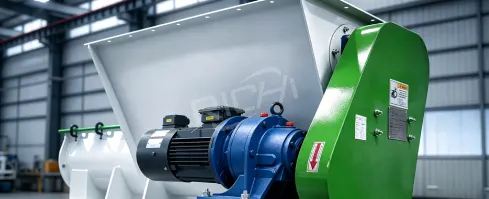
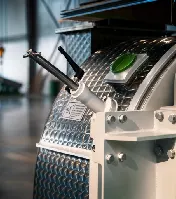
Hemp is long, light, and easy to bridge. The anti-bridging feeder keeps material moving with a double-shaft agitation system. The force feeder then pushes the material horizontally into the pelletizing chamber. Without this, the die is starved in one minute and flooded the next.

Control System
A PLC control system allows the operator to monitor feeder speed, conditioner temperature, motor current, and safety alarms. Recipes can be stored and recalled. On a good line, the PLC is linked to the VFDs and the batching system.
Cutter
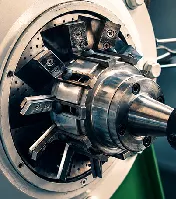
Hemp pellets are often cut at 1.5–2 times the diameter, but fuel pellets may be longer. The cutter must be kept sharp and close to the die surface. If it is too far away, the pellets break unevenly and fines increase.
Drive System
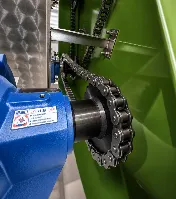
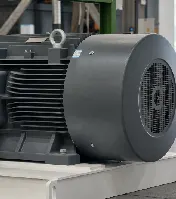
The main drive usually consists of a Siemens motor, coupling, gearbox, and main shaft. Our machines utilize gear transmission, which offers a transmission efficiency approximately 15% higher than that of traditional belt drives. For bearings, we select products from renowned brands such as SKF or FAG.
Lubricate & Safety Pin
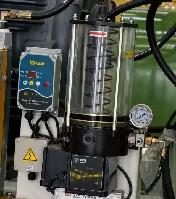
Automatic lubrication and safety pins are a major advantage on hemp fiber lines. They keep rollers and main shaft bearings running smoothly under high load and dust, while protecting the main drive. If a hard object enters the die, the safety pin breaks—saving the gearbox from damage and costly downtime.
Ring Die & Press Rollers
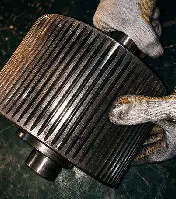
The die is the wear part. Alloy steel, carburized, with a compression ratio matched to the application. Press rollers are hard-faced. Roller-to-die clearance is set so that the die turns freely with the rollers just kissing it. Too tight and you’ll gall the die. Too loose and material squeezes past without forming.



Various Capacities
Below are MZLH ring-die models for hemp fuel pellets. Capacities are based on dry hemp, 2–12 mm pellets, and stable feeding. Your local moisture and die compression can shift output.
| Model | MZLH320 | MZLH350 | MZLH420 | MZLH520 | MZLH678 | MZLH768 |
| Main Motor Power(kw) | 22 | 37 | 90 | 132 | 200 | 250 |
| Arch-breaking Feeder Power(kw) | 2.2 | 2.2 | 3 | 3 | 3 | 4 |
| Forced Feeder Power(kw) | 0.75 | 0.75 | 1.5 | 1.5 | 1.5 | 1.5 |
| Ring Die Inner Diameter(mm) | 320 | 350 | 420 | 520 | 673 | 762 |
| Finished Particle Diameter(mm) | 2~12 | |||||
| Output(T/H) | 0.2-0.3 | 0.3-0.5 | 1.0-1.2 | 1.5-2.0 | 2.5-3.0 | 3.0-4.0 |
You can achieve your target output by selecting the appropriate hemp pellet mill model or using pelletizers in parallel; we offer a wide range of configurations—including basic, low-spec, standard, high-spec, fully automatic, semi-automatic, and PLC-controlled systems—to meet your needs.
Please refer to the industrial hemp pellet mill we have delivered. Capacity, pellet size, and reference pricing are subject to raw materials, application scenarios, and site conditions. If you have industrial hemp requiring processing, please contact us to discuss a processing solution.
Hemp Pellet Mill Delivered Worldwide
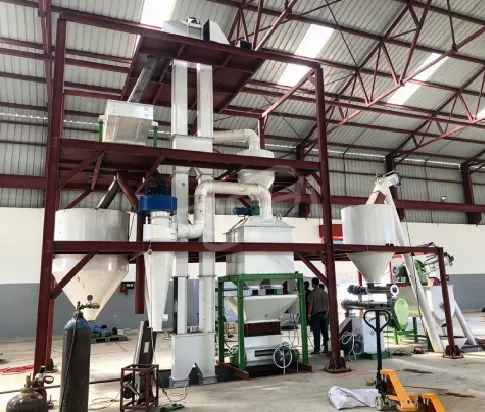
Netherlands
Netherlands 1–2 T/H Hemp Pellet Machine Purchase
Date: September 2023
Guide Price: $115,000
Finished Pellets: 4–6 mm pellets for use as pet bedding (rabbits, hamsters)
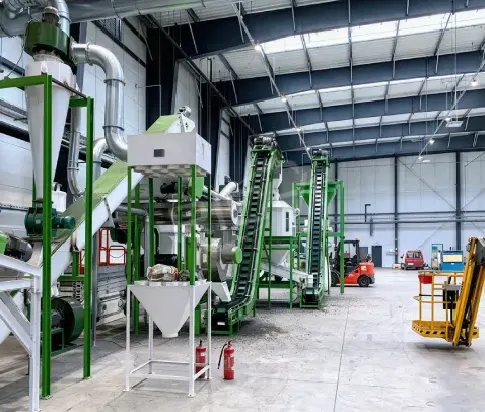
France
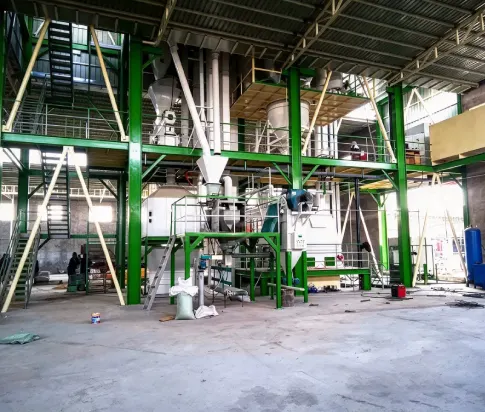
France 5–10 T/H Hemp Fiber Pelletizing Line
Date: April 2022
Guide Price: $360,000
Finished Pellets: 6–10 mm hemp pellets used as construction material filler
Canada
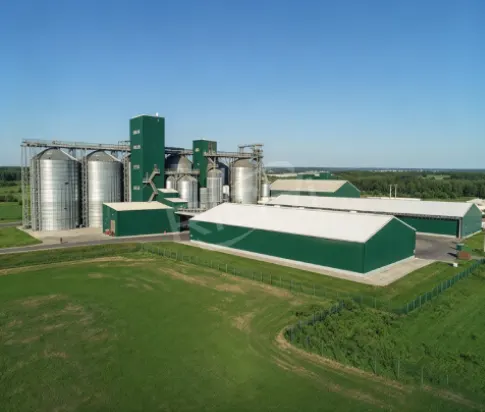
Canada 10 T/H Hemp Pelletizer Equipment Purchase
Date: March 2020
Guide Price: $480,000
Finished Pellets: 6–8 mm biomass fuel pellets for winter heating
US
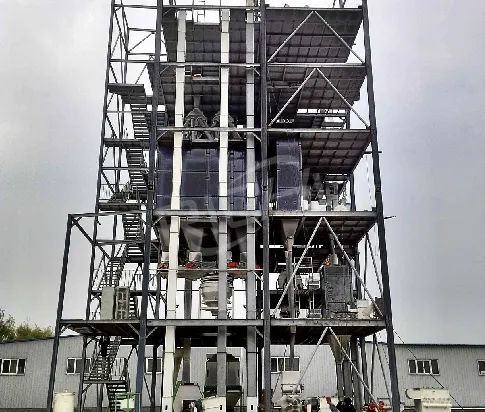
US 10–15 T/H Hemp Pellet Production Line
Date: May 2019
Guide Price: $560,000
Finished Pellets: 4–8 mm grain-free forage pellets for beef cattle
Germany
Germany 15 T/H Hemp Pellet Production Line
Date: July 2021
Guide Price: $650,000
Finished Pellets: 6–8 mm fuel pellets for residential fireplaces and industrial boilers
How to Make Leaf Pellets
Start with testing, not with a full truck of hemp.
01 Raw Material Crushing
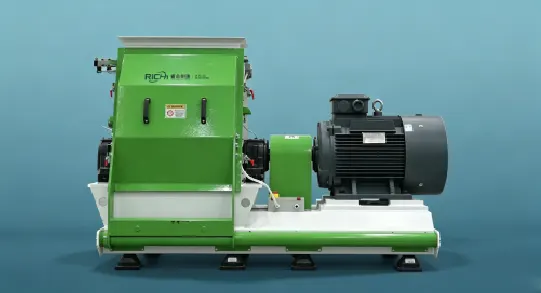
Hemp stalks, leaves, and residues are ground by a hammer mill. For fuel pellets, 2–3 mm is a common target. For feed, the fineness may be slightly coarser or finer depending on the animal. Magnets should be installed before the mill to catch nails, wire, and other tramp metal.
SFSP Teardrop-style Hammer Mill
Learn More →
02 Mixing
For mixed feed, you blend the hemp meal with grain, protein, minerals, and additives in a mixer. A double-shaft paddle mixer or a ribbon mixer is common. In practice, mixing time must be long enough to reach uniformity, but not so long that light and heavy particles separate again.
SLHJ Single-Shaft Double-Layer Paddle Mixer, SLHSJ Twin-Shaft Paddle Mixer, SLHY Single-Shaft Double-Ribbon Mixer, STHJ High-Speed Molasses Mixer
Learn More →

03 Pelletizing
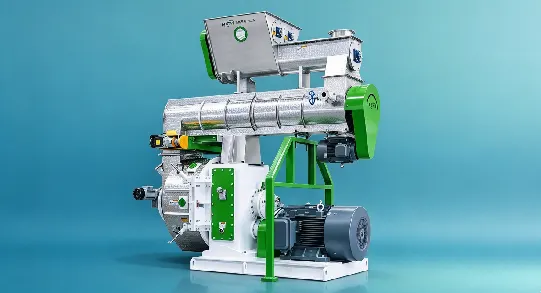
The feeder pushes the mixed material into the hemp pellet mill. Inside the chamber, the ring die and rollers compress the material into pellets. Meanwhile, the operator watches the main motor current, die temperature, and pellet appearance. Consequently, they continuously make small adjustments to the feed rate and moisture. It’s a balancing act.
MZLH Hemp Pellet Mill
Learn More →
04 Drying
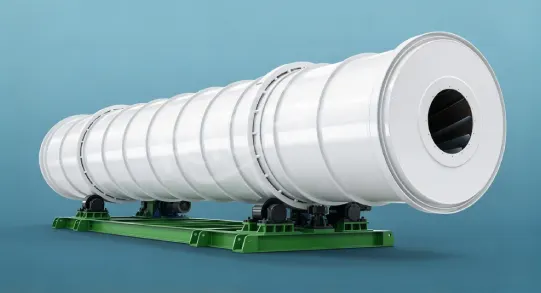
Drying may happen before or after pelletizing, and it completely depends on the product. For fuel pellets, you usually dry the raw material before pelletizing. However, feed pellets often don't require a dryer. For organic fertilizer pellets, drying is usually necessary after pelletizing.
WDHG Mesh-belt Circulating Dryer, DHG Mesh-belt Dryer, Rotary Drum Dryer
Learn More →
05 Cooling
Hot pellets must be cooled before storage. How? Ambient air is drawn through the pellet bed to remove the heat. Typically, this cooling time takes 6–15 minutes. After cooling, the pellet temperature should sit close to room temperature (room temperature plus 3–5°C).
SKLF Flap-type Counterflow Cooler, SKLY Impeller-type Counterflow Cooler
Learn More →

06 Screening and Packaging
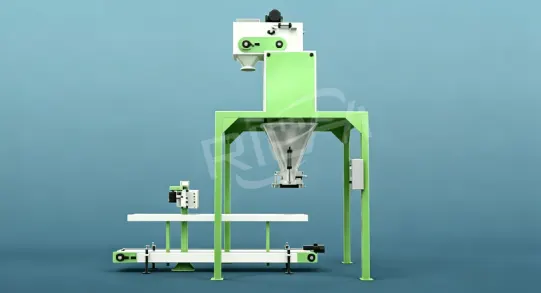
A vibrating screen or rotary screener removes fines and oversized pellets. Good pellets go to the packing scale; fines are returned to the pellet mill for re-pelletized. Packaging can be 10–50 kg bags, bulk bags, or bulk trucks. The bagging scale must match the pellet size and flowability.
TBLMa Series Pulse Dust Collector, SFJZ Series Vibrating Screen, SFJH Series Rotary Grading Sieve, DCS Series Fully Automatic Packaging Scale
Learn More →
How to Choose the Right Hemp Pellet Mill
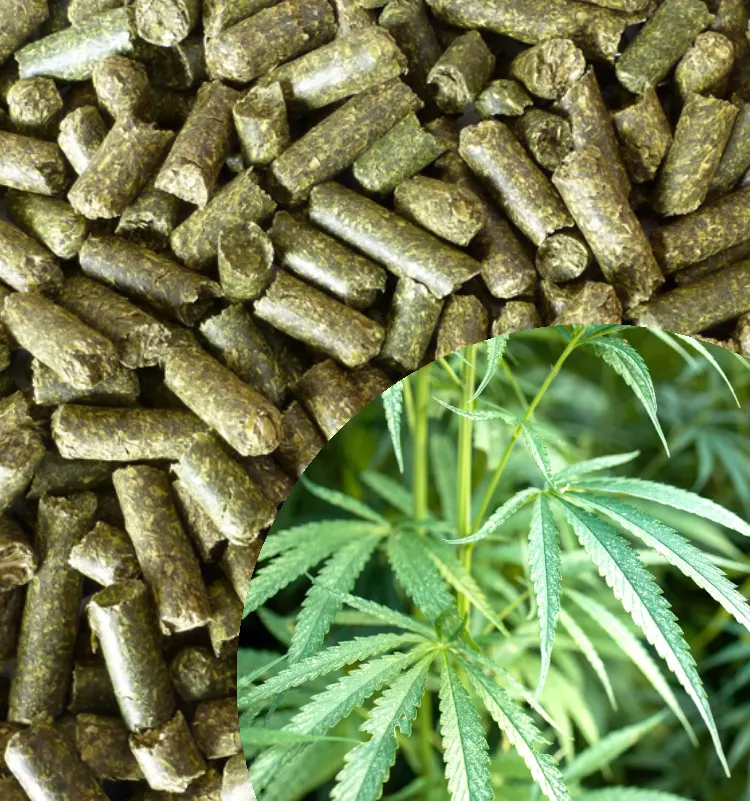
In actual production, final equipment selection decisions and actual procurement costs often depend on a comprehensive assessment of various internal and external factors, including raw material consistency, moisture content, fiber length, intended product use, local regulations, facility height, power supply, heat source conditions, level of automation, labor availability, and the supply of spare parts. These factors should be taken into account when formulating the cannabis pellet production plan.
HEMP
Raw Material Characteristics
First, define the raw material. Is it hemp leaf, hurd, bast fiber, stalk, straw, or a mix? What is the moisture? What is the fiber length? Is there sand or stone? Hemp with long bast fiber needs an anti-bridging feeder. Meanwhile, hemp with high silica needs wear-resistant dies. If it has high moisture, it needs drying.
HEMP
Product Application and Scale
Are you making fuel, feed, bedding, or fertilizer? Fuel pellets need density and low ash. Feed pellets need proper conditioning and nutrition. Bedding pellets need absorbency and low dust. Fertilizer pellets need drying and a low compression ratio. The application decides the machine configuration.
HEMP
Target Output
Capacity must be based on the actual material. If you need 10 t/h of 100% hemp feed pellets, you may need multiple MZLH520-class machines. If the formula is 40% hemp and 60% grain, one MZLH420 may be enough for a smaller line. Always ask for a capacity guarantee based on your formula.
HEMP
Auxiliary Equipment Requirements
A hemp pellet mill alone cannot constitute a complete production line; additional equipment is required, such as a crusher, mixer, conveyor, iron remover, dryer, cooler, screener, dust collector, and packaging scale. Feed production requires a boiler, whereas fuel production requires a dryer and, in some cases, a binder addition system.
HEMP
Plant Implementation Conditions
Check the site before you promise a layout. How high is the building? Can you dig a pit? What is the power supply? Do you have steam, gas, or biomass for the dryer? What is the local law for industrial hemp? Hemp processing may require permits.
FAQ About Leaf Pellet Production
We frequently receive the same practical questions from customers looking to purchase hemp pellet mill: Can the machine process both feed pellets and fuel pellets? What is the production capacity of a single unit? Is a dryer or hammer mill required? Below, our engineers provide answers based on real-world project experience. You can review this information and then send us details about your raw materials to receive a customized quote.
How much does a hemp pellet mill cost?
→
Small units — 0.2–0.5 t/h — start around $7,000–$15,000 for the mill alone. A complete 1–2 t/h line with grinder, mixer, dryer, cooler, and bagging runs $40,000–$80,000. Above 3 t/h, prices climb steeply. The mill is usually 30–40% of the total line cost. Everything else is the support equipment.
Why does my hemp pellet mill keep plugging?
→
Nine times out of ten, it's feed rate. The forced feeder is running too fast for the conditioner to keep up. Material enters the die chamber under-conditioned — dry, stiff, and impossible to extrude. The other possibility is die compression. If you're running a low-compression die on high-fiber hemp, the material won't bind. Check your die spec against the material.
My pellets come out crumbly. What's wrong?
→
Three usual suspects: moisture too low, conditioner temperature too low, or die compression too low. Run a moisture check on the conditioned material right at the die inlet. If it's below 14% for feed or 13% for fuel, add steam. In case the conditioner outlet temperature is under 70°C, your steam supply is weak. If both check out, the die is wrong.
Can I run hemp and wood on the same die?
→
You can, but you won't like the results. Hemp needs higher compression and a different surface finish on the die holes. Wood dies run lower compression. Switching back and forth wears the die unevenly and gives you mediocre pellets on both. If you're running both materials regularly, buy two dies.
How much fiber can I put in a feed pellet before it falls apart?
→
Ruminant feed can handle 40–60% hemp fiber if the conditioner is doing its job. Poultry feed is trickier — above 15–20% hemp fiber, pellet durability drops off. The grain starch in the mix acts as a binder. More starch, more fiber tolerance. If you're pushing high fiber percentages, consider adding a small amount of binder — starch, molasses, or lignin — to keep PDI above 80%.
Do I need a dryer for feed pellets?
→
Usually not for pure hemp feed if the incoming moisture is under 14%. The friction in the die drives off some moisture. But if you're blending in high-moisture ingredients or running a low-compression die that generates less friction heat, you might need one. Test your PDI. If it's below 80%, drying is the first thing to try.
What's the difference between hemp feed pellets and hemp fuel pellets?
→
Die compression, moisture target, and downstream equipment. Feed pellets run lower compression — you want them to break down in the animal's stomach. Fuel pellets run higher compression for density and burn time. Feed needs conditioning; fuel often doesn't. Feed pellets bagged at 10–50 kg; fuel pellets bulk or ton bags. Same machine, different setup.
Can I pelletize fresh hemp without drying it first?
→
No. Fresh hemp runs 60–70% moisture. The die can't handle that — material squeezes past the rollers instead of through the holes. You need to get it down to 14–16% before it touches the mill. That means a dryer, or field drying if your climate allows. There's no shortcut here.
What's the typical PDI for hemp pellets?
→
For feed, you want above 80%. For fuel, above 90% is the target. If you're below those numbers, check moisture, conditioner temperature, die wear, and feed rate — in that order. PDI is the single most useful number for troubleshooting pellet quality.
How often do I need to change the die?
→
Depends on throughput and material abrasiveness. On hemp straw with a good quality carburized die, you might get 800–1,200 hours before the die needs resurfacing or replacement. Seed meal is gentler — 1,500–2,000 hours is achievable. Keep a spare die on the shelf. It is recommended to stock spare molds to avoid prolonged production stoppages caused by mold wear.
Still unsure? Every situation regarding hemp raw material is different. Moisture content, ash content, fiber characteristics, and local power supply all influence the design of the production line. Please provide samples and your target production capacity, and we will recommend the appropriate hemp pellet mill model, ring die compression specifications, and a complete production line layout.
More Biomass Pellet Machines
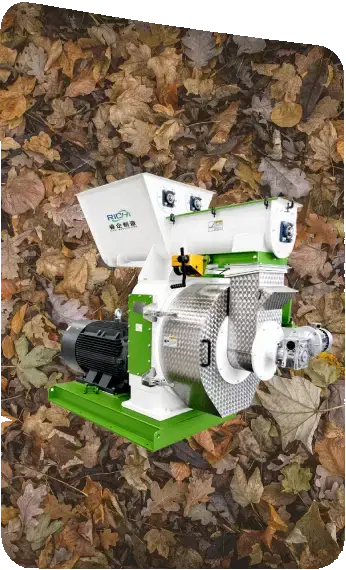
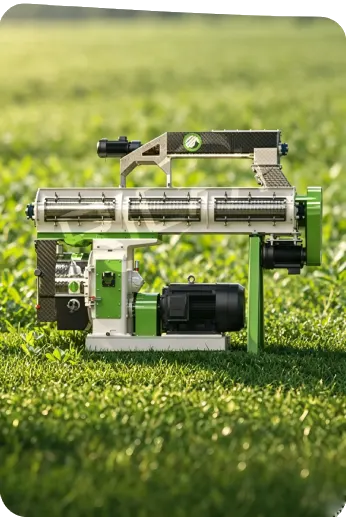
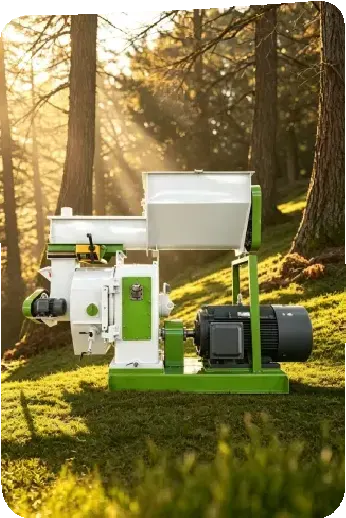
Our hemp pellet mill delivers stable biomass pellet production. We also design specialized pellet mills to process diverse raw materials. Explore our alternative models built for EFB, alfalfa, waste paper and sawdust to match your unique feed, bedding or fuel manufacturing demands.
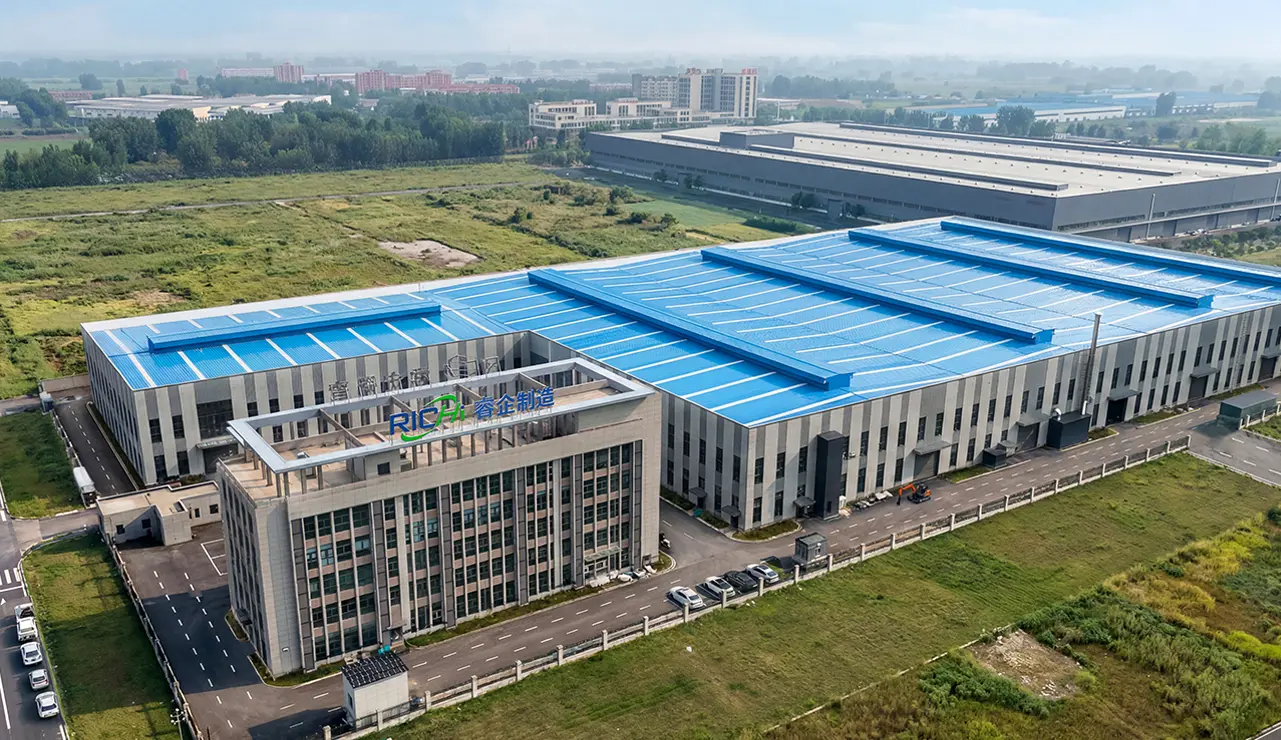
Who are we?
RICHI Machinery Co., Ltd., established in 1995, is a professional manufacturer integrating R&D, manufacturing, design and installation of complete sets of feed machinery engineering, complete sets of biomass pellet engineering, steel silo engineering and automation control.
Certifications & Honors
RICHI has obtained numerous international authoritative certifications, including CE, ISO9001, SGS, German TÜV, Russian RTN, and French BV, and holds 23 patents. The company has been recognized as a Henan Provincial High-Tech Enterprise, a Zhengzhou Municipal "Specialized, Refined, and Innovative" SME, and a member of the Henan Provincial International Trade E-commerce Association.
60,000㎡+
production base
23+
Patents obtained
30+
Years Of Experience
2000+
successful projects
Product System & Global Service
RICHI has developed a diverse and comprehensive product system, covering 15 major series and over 200 products, including feed pellet mills, wood pellet mills, organic fertilizer pellet mills, aquaculture extrusion extruders, and cat litter pellet mills. This system can comprehensively meet the needs of various feed production and biomass pellet processing.
Leveraging a comprehensive international marketing network, its products are sold in 131 countries and regions worldwide, with over 2000 projects implemented and annual exports exceeding 100 million RMB, serving customers globally.